Table of Contents
Synonym for Embarrass: 20 Alternatives With Meanings and Examples
Have you ever searched for the perfect word to describe an awkward moment? Perhaps someone made a mistake during a presentation, received an unexpected compliment, or shared a personal story at the wrong time. In each situation, the word embarrass might fit, but another word could express the feeling more clearly.
Finding the right synonym for embarrass helps you communicate the exact emotion you mean. Words such as shame, humiliate, mortify, and fluster share similar meanings, yet each carries a slightly different tone. Some describe mild discomfort, while others suggest a much deeper loss of dignity.
This guide explores 20 useful alternatives, explains their differences, and provides practical examples. You’ll also discover synonyms for feeling embarrassed, words for embarrassing situations, antonyms, and tips for choosing the most natural expression.
What Does Embarrass Mean?
The verb embarrass means to make someone feel uncomfortable, self-conscious, nervous, or ashamed. This feeling often appears when a person attracts unwanted attention, makes a mistake in public, or faces an unexpected social situation.
According to the Cambridge Dictionary’s definition of embarrass, the word describes causing someone to feel nervous, worried, or uncomfortable. The feeling can range from mild awkwardness to intense shame.
For example, imagine that your teacher praises your work in front of the entire class. You might feel embarrassed because everyone suddenly looks at you. However, if someone reveals a private mistake to make you look foolish, the experience could feel much more painful.
The word also appears in professional and everyday situations. A company might embarrass itself by publishing an inaccurate announcement, or a speaker might embarrass a colleague by revealing confidential information during a meeting.
Different Forms of the Word Embarrass
Understanding related word forms makes it easier to use the term correctly.
| Word form | Part of speech | Example |
|---|---|---|
| Embarrass | Verb | Please don’t embarrass your friend. |
| Embarrassed | Adjective | She felt embarrassed after forgetting her lines. |
| Embarrassing | Adjective | It was an embarrassing mistake. |
| Embarrassment | Noun | He tried to hide his embarrassment. |
| Embarrassingly | Adverb | The team performed embarrassingly poorly. |
Remember the difference between embarrassed and embarrassing. A person feels embarrassed, while a situation or action can be embarrassing.
What Is the Best Synonym for Embarrass?
The best synonym depends on what happened, how the person felt, and how strongly you want to describe the experience. No single alternative works perfectly in every situation.
For everyday conversation, make uncomfortable is a clear and gentle choice. If someone feels deeply ashamed, mortify or humiliate may communicate the experience more accurately. Meanwhile, fluster works well when a person becomes nervous and struggles to respond.
Consider these examples:
- Embarrass: The unexpected question embarrassed him.
- Fluster: The unexpected question flustered him, and he lost his train of thought.
- Mortify: The public announcement mortified him.
- Humiliate: The manager humiliated the employee by mocking his mistake in front of the team.
- Disconcert: The interviewer’s unusual question disconcerted the candidate.
Each sentence describes discomfort, but the details change the meaning. Fluster emphasizes nervous confusion, mortify suggests intense embarrassment, and humiliate highlights an attack on someone’s dignity.
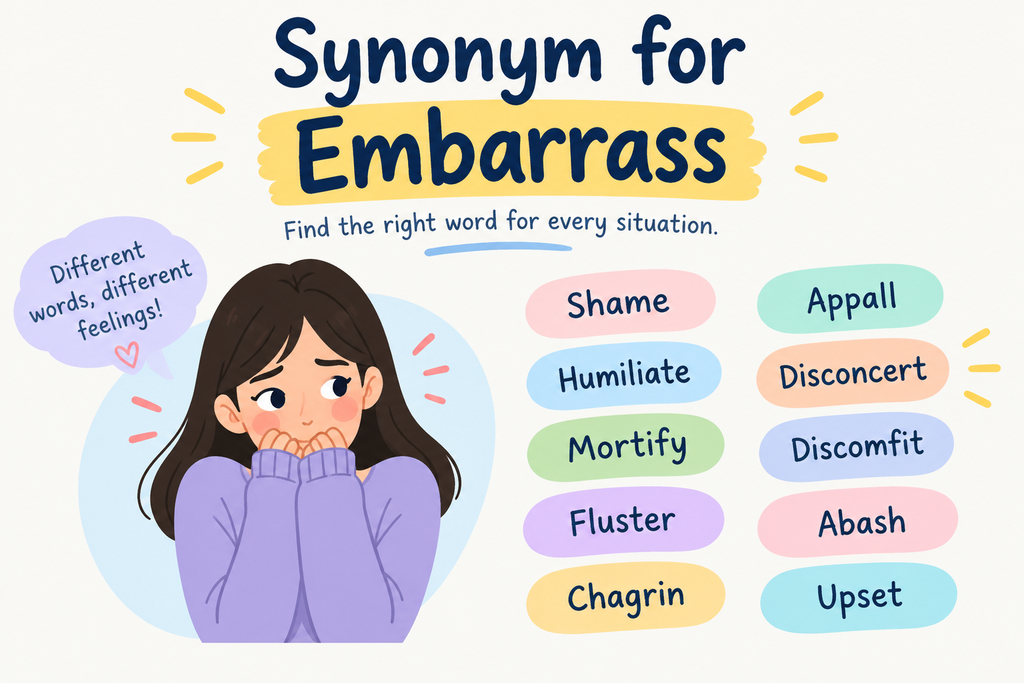
The Cambridge Thesaurus and Collins English Thesaurus list several related words, including abash, chagrin, discomfit, disconcert, and mortify.
20 Synonyms for Embarrass and Their Meanings
Choosing a suitable alternative becomes easier when you understand the emotion behind each word. The following synonyms cover mild discomfort, nervousness, shame, and more intense experiences.
| Synonym | Meaning | Example sentence |
|---|---|---|
| 1. Shame | To make someone feel guilty or ashamed | His careless comment shamed his friend. |
| 2. Humiliate | To make someone feel deeply ashamed or less respected | The coach refused to humiliate a player for one mistake. |
| 3. Mortify | To cause intense embarrassment | Forgetting her speech mortified her. |
| 4. Abash | To make someone feel self-conscious or lose confidence | His sharp criticism abashed the young speaker. |
| 5. Discomfit | To make someone uncomfortable or confused | The unexpected question discomfited the presenter. |
| 6. Disconcert | To disturb someone’s confidence or composure | The interviewer’s sudden change of topic disconcerted him. |
| 7. Fluster | To make someone nervous or confused | The rapid questions flustered the student. |
| 8. Rattle | To disturb someone’s confidence or concentration | The unexpected interruption rattled the speaker. |
| 9. Faze | To unsettle or bother someone | The minor mistake didn’t faze the experienced teacher. |
| 10. Chagrin | To cause disappointment or embarrassment | To her chagrin, she sent the message to the wrong group. |
| 11. Discompose | To disturb someone’s calm | The unexpected announcement discomposed the audience. |
| 12. Upset | To cause emotional distress | His thoughtless remark upset his friend. |
| 13. Distress | To cause serious worry or emotional discomfort | The public criticism distressed the young employee. |
| 14. Confuse | To make someone uncertain or unable to understand | The unclear instructions confused the new student. |
| 15. Bewilder | To confuse someone greatly | The complicated question bewildered the contestant. |
| 16. Perplex | To puzzle or confuse someone | The unusual response perplexed the interviewer. |
| 17. Disgrace | To damage someone’s reputation or honor | The dishonest decision disgraced the organization. |
| 18. Degrade | To treat someone as less worthy | A good leader doesn’t degrade employees for their mistakes. |
| 19. Demean | To lower someone’s dignity through disrespectful treatment | The supervisor refused to demean anyone during the review. |
| 20. Put on the spot | To force someone to respond under pressure | The unexpected question put the guest on the spot. |
These alternatives are related, but they aren’t exact replacements in every sentence. For example, bewilder means to confuse someone, while disgrace focuses on damage to reputation or honor. Use the word that matches the actual situation rather than choosing one simply because it appears in a synonym list.
Which Synonyms Are Most Common in Everyday English?
For everyday writing and conversation, start with familiar expressions such as make uncomfortable, fluster, upset, humiliate, and make someone feel ashamed.
Less common words such as abash and discompose can add variety to formal writing or literary descriptions. However, simpler expressions often communicate the same idea more clearly.
For example, instead of writing, “The announcement discomposed the audience,” you could say, “The announcement made the audience uncomfortable.” The second sentence is easier for most readers to understand.
Stronger Words for Embarrass
Sometimes ordinary embarrassment doesn’t fully describe an experience. A person might feel deeply ashamed after a serious mistake or lose confidence when someone publicly attacks their dignity. In such cases, a stronger synonym can communicate the emotional impact more accurately.
Humiliate
Humiliate describes making someone feel deeply ashamed or damaging their sense of dignity. It often suggests that another person treated them disrespectfully.
Example: A supervisor humiliated an employee by mocking a minor mistake during a team meeting.
This word is especially useful when the embarrassment involves ridicule, disrespect, or an imbalance of power. The Merriam-Webster Thesaurus entry for humiliate includes related words such as degrade, demean, disgrace, and shame.
Mortify
Mortify expresses intense embarrassment. People often use it when something happens that makes them wish they could escape the attention immediately.
Example: I was mortified when I realized that I had called my professor by the wrong name.
Unlike humiliate, which often suggests an attack on dignity, mortify can describe a person’s own reaction to an awkward mistake.
Shame
Shame emphasizes a painful feeling connected to wrongdoing, disapproval, or a sense of having failed.
Example: He felt ashamed after taking credit for someone else’s work.
Use shame when guilt or moral judgment plays an important role. For ordinary social awkwardness, embarrass may be the more accurate choice.
Disgrace
Disgrace suggests serious damage to a person’s reputation, honor, or standing in a community.
Example: The public discovery of the organization’s dishonest practices brought disgrace upon its leadership.
This word often suits formal writing, news reporting, and discussions about reputation. It’s usually too strong for small social mistakes.
Mild or Casual Alternatives to Embarrass
Not every awkward moment is a major problem. Sometimes a person simply feels nervous, loses concentration, or struggles to respond. In these cases, milder alternatives help you avoid exaggerating the situation.
Fluster
Use fluster when someone becomes nervous or confused, especially under pressure.
Example: The interviewer asked three questions in quick succession and flustered the candidate.
The word focuses on a person’s reaction rather than shame. A flustered person might know the correct answer but struggle to explain it clearly.
Rattle
Rattle suggests that something disrupts a person’s confidence or concentration.
Example: The unexpected criticism rattled the presenter, but she soon continued her speech.
This word works particularly well in stories about competitions, presentations, interviews, and other high-pressure situations.
Faze
Faze means to unsettle or bother someone. It’s often used in negative sentences to show that a person remains calm.
Example: The difficult question didn’t faze the experienced speaker.
Although faze can overlap with embarrass, it doesn’t necessarily involve shame. Something can faze a person simply because it’s surprising or challenging.
Make Someone Uncomfortable
This straightforward phrase works when you want to describe awkwardness without implying humiliation.
Example: His personal questions made the guests uncomfortable.
It’s especially useful in professional communication because it describes the effect of someone’s behavior without making an unnecessarily harsh judgment.
Another Word for Embarrassed or Ashamed
The words embarrassed and ashamed often appear together, but they describe different feelings. Understanding the distinction helps you choose the right adjective.
Embarrassed usually describes discomfort caused by unwanted attention, awkwardness, or a mistake. Ashamed more often involves guilt, regret, or a belief that someone has done something wrong.
For example, a student might feel embarrassed after stumbling over a word during a presentation. The same student might feel ashamed after deliberately copying another student’s work.
Here are some related adjectives and phrases:
| Word or phrase | Meaning | Example |
|---|---|---|
| Embarrassed | Uncomfortable or self-conscious | He felt embarrassed when everyone turned to look at him. |
| Ashamed | Feeling guilt or strong disapproval of one’s actions | She felt ashamed of her dishonest decision. |
| Mortified | Extremely embarrassed | He was mortified when he forgot his lines. |
| Self-conscious | Uncomfortable because you’re aware of others’ attention | She felt self-conscious speaking to a large audience. |
| Flustered | Nervous and confused | I became flustered when the questions started. |
| Abashed | Suddenly shy or embarrassed | He looked abashed after the correction. |
| Chagrined | Disappointed or annoyed, often with embarrassment | She was chagrined to discover the mistake. |
| Humiliated | Made to feel deeply ashamed or disrespected | The public insult left him feeling humiliated. |
Embarrassed vs. Ashamed: What’s the Difference?
Imagine that you accidentally spill water during a family dinner. You might feel embarrassed because everyone notices the accident.
Now imagine that you knowingly blame another person for the spill. If you later recognize that your accusation was unfair, you might feel ashamed.
The first situation involves social discomfort. The second involves regret about your behavior.
These feelings can overlap. Someone can feel both embarrassed and ashamed after making a mistake, especially if the mistake affects another person.
Another Word for Embarrassed in a Good Way
Embarrassment doesn’t always come from a mistake or an uncomfortable event. Sometimes a person feels shy, pleased, or overwhelmed when receiving praise, affection, or unexpected attention.
Imagine that your classmates surprise you with an award. You smile, look down, and struggle to respond because you didn’t expect such recognition. In that situation, flattered or bashful may describe your reaction better than ashamed.
Consider these expressions:
- Flattered: Feeling pleased because someone has expressed admiration or appreciation.
- Bashful: Feeling shy, especially when receiving attention or praise.
- Shyly pleased: Feeling happy while showing some shyness.
- Self-conscious: Becoming unusually aware of yourself because others are paying attention.
- Touched: Feeling emotionally moved by a kind gesture.
Example: “I felt flattered when my teacher praised my presentation in front of the class.”
Another example is, “She gave a bashful smile when her friends complimented her artwork.”
These expressions aren’t exact synonyms for embarrassed. They describe the positive feelings that can accompany a shy or awkward reaction. Choose one when the situation involves happiness or appreciation rather than shame.
Synonyms for an Embarrassing Situation
Sometimes you need a noun or phrase to describe an awkward event rather than a person’s emotional reaction. These expressions work well in essays, stories, emails, and everyday conversations.
| Word or phrase | Meaning | Example |
|---|---|---|
| Awkward moment | A situation that feels uncomfortable or unnatural | There was an awkward moment when nobody answered the question. |
| Uncomfortable situation | An event that causes unease | The disagreement created an uncomfortable situation. |
| Embarrassing incident | An event that causes embarrassment | Forgetting the guest’s name became an embarrassing incident. |
| Social blunder | A mistake in social behavior | Interrupting the introduction was a social blunder. |
| Faux pas | A socially inappropriate mistake | Discussing a sensitive topic at dinner was a faux pas. |
| Misstep | An error in judgment or action | The careless comment was a professional misstep. |
| Gaffe | An embarrassing public mistake or remark | The spokesperson made a gaffe during the interview. |
| Sticky situation | An awkward or difficult circumstance | The conflicting invitations created a sticky situation. |
How to Choose the Right Phrase
The best phrase depends on the kind of event you’re describing.
Use awkward moment for a brief period of discomfort. Choose social blunder when someone breaks an unwritten social rule. A gaffe often involves a noticeable mistake in public communication, while faux pas is useful when describing a breach of etiquette.
For example, if someone accidentally interrupts a conversation, an awkward moment may be enough. If a company representative makes an inappropriate remark during a public interview, gaffe may communicate the situation more precisely.
These phrases also make writing more specific. Instead of repeating “embarrassing situation” several times, choose the expression that explains what actually happened.
Embarrass Synonyms and Antonyms
A synonym has a similar meaning to another word, while an antonym expresses an opposite or contrasting meaning. Learning both can help you express emotional changes more clearly.
The best antonym for embarrass depends on the context. If someone makes another person feel awkward, put at ease may express the opposite action. If someone causes shame, reassure or encourage may offer a useful contrast.
| Antonym or contrasting phrase | Meaning | Example |
|---|---|---|
| Put at ease | Help someone feel comfortable | The host put the nervous guest at ease. |
| Reassure | Help someone feel less worried | Her friend reassured her after the mistake. |
| Comfort | Offer support to someone who feels upset | The teacher comforted the student after the difficult presentation. |
| Encourage | Help someone feel more confident | The coach encouraged the player to try again. |
| Praise | Express approval or admiration | The manager praised the employee’s careful work. |
| Honor | Show respect or recognition | The organization honored the volunteers. |
| Compliment | Express admiration for someone or something | Her classmates complimented her creative project. |
| Celebrate | Show happiness about an achievement or event | The team celebrated everyone’s contribution. |
These words don’t all act as direct grammatical opposites. For example, compliment isn’t the exact antonym of embarrass in every sentence. However, it can provide a useful contrast when embarrassment results from unwanted attention or criticism.
Examples of Synonyms and Antonyms in Context
Consider the sentence, “The unexpected question embarrassed the speaker.”
You could rewrite it as follows:
- Similar meaning: The unexpected question flustered the speaker.
- Stronger effect: The unexpected question mortified the speaker.
- Opposite emotional effect: The friendly introduction put the speaker at ease.
Notice how each version changes the meaning slightly. The goal isn’t simply to replace words. It’s to communicate the intended feeling accurately.
How to Use Embarrass Synonyms in Sentences
Choosing a synonym becomes easier when you consider the setting, the intensity of the emotion, and the effect on the person involved.
In School and Education
Students experience awkward moments when answering questions, presenting projects, or learning new skills. The right word can describe these situations without exaggerating them.
Examples:
- “The unexpected question flustered the student.”
- “He felt embarrassed after forgetting his presentation notes.”
- “The teacher corrected the error without humiliating the student.”
- “She was chagrined when she discovered a mistake in her homework.”
Notice that the third sentence emphasizes the teacher’s respectful behavior. It also shows how word choice can communicate more than an emotion.
In the Workplace
Professional writing benefits from precise language. A word such as disconcert may describe a sudden loss of confidence, while humiliate can highlight disrespectful treatment.
Examples:
- “The unexpected change in the meeting agenda disconcerted the team.”
- “The manager addressed the error privately instead of humiliating the employee.”
- “The inaccurate announcement embarrassed the organization.”
- “The challenging interview question rattled the candidate.”
When writing workplace reports, describe what happened before assigning a strong emotional label. For example, “The manager criticized the employee in front of the team” provides a concrete description. You can then explain that the employee felt humiliated.
In Everyday Conversation
Casual conversations often call for simple, natural phrases rather than formal vocabulary.
Examples:
- “Don’t put me on the spot!”
- “That comment made me uncomfortable.”
- “I was mortified when I sent the message to the wrong group.”
- “The surprise compliment made her bashful.”
- “The mistake didn’t faze him.”
These expressions sound natural because they fit common situations. You don’t need a complicated word when a familiar phrase communicates the same idea.
In Creative Writing
Writers can use synonyms to show emotion without repeating the same word. Instead of writing that a character feels embarrassed in every scene, describe the exact reaction.
For example:
“Jordan stumbled over the first sentence of his speech. When the room fell silent, he felt mortified. A friendly smile from the audience helped him regain his confidence.”
The passage shows the character’s emotional shift through events and reactions. It also avoids relying on the same adjective repeatedly.
Practical Case Studies: Choosing the Right Synonym
The following fictional examples demonstrate how context changes the best word choice.
Case Study: A Mistake During a Presentation
Maya prepares carefully for a class presentation but forgets the next line when she reaches the front of the room. She pauses, looks at her notes, and starts again.
Best word: Flustered
Maya becomes nervous and briefly loses her train of thought. The mistake doesn’t necessarily damage her dignity or reputation, so flustered is a reasonable choice.
If classmates deliberately mocked her mistake, humiliated might describe her experience more accurately.
Case Study: An Unwanted Public Compliment
Daniel receives an unexpected award during a school assembly. Everyone applauds, and he smiles while struggling to find the right words.
Best word: Bashful or flattered
Daniel feels pleased by the recognition but isn’t sure how to respond to the attention. Bashful describes his shyness, while flattered captures his appreciation.
Calling him ashamed would suggest guilt or disapproval that the situation doesn’t support.
Case Study: An Unprofessional Meeting
A team leader repeatedly mocks an employee’s mistakes during meetings. The employee becomes reluctant to share ideas because he expects further criticism.
Best word: Humiliated
The repeated public criticism attacks the employee’s dignity rather than merely creating a moment of awkwardness. Humiliated communicates that stronger effect.
The example also illustrates why word choice matters in professional reports. Describing the behavior precisely helps readers understand the difference between constructive feedback and disrespect.
Common Mistakes When Choosing an Embarrass Synonym
Even words with similar meanings can create confusion when writers use them without considering context.
Treating Every Synonym as Identical
Fluster, shame, and humiliate don’t communicate the same experience. A flustered person may simply be nervous, while a humiliated person feels that someone has damaged their dignity.
Better approach: Identify the main emotion before selecting a replacement.
Using Strong Words for Minor Events
Words such as disgrace and humiliate can sound excessive when describing a small mistake.
For example, “I was disgraced because I forgot my notebook” may sound unnatural unless the situation genuinely involves serious damage to reputation.
Better approach: Use embarrassed, awkward, or flustered for ordinary mistakes.
Confusing Embarrassment With Guilt
Someone can feel embarrassed without believing they’ve done anything wrong. Receiving unexpected praise, forgetting a name, or stumbling over a word can cause discomfort without guilt.
Better approach: Use ashamed when guilt or strong self-disapproval matters. Use embarrassed when awkwardness or unwanted attention is the main issue.
Choosing Unfamiliar Words Just to Sound Sophisticated
Words such as abash and discompose can be useful, but they may sound unnatural in casual writing.
Better approach: Match your vocabulary to your audience. Clear language usually communicates ideas more effectively than complicated wording.
Frequently Asked Questions About Synonyms for Embarrass
What Is the Closest Synonym for Embarrass?
Make uncomfortable is a clear everyday alternative. Depending on the context, shame, mortify, fluster, or humiliate may be more accurate.
What Is a Stronger Word for Embarrass?
Humiliate and mortify are strong alternatives. Humiliate emphasizes damage to dignity, while mortify describes intense embarrassment.
Is Mortify Stronger Than Embarrass?
Usually, yes. Mortify often suggests a more intense or painful form of embarrassment, although the precise meaning depends on the sentence.
What Is the Difference Between Embarrass and Humiliate?
Embarrass can describe mild discomfort caused by an awkward event or unwanted attention. Humiliate usually suggests a deeper feeling of shame or an attack on dignity.
What Is the Opposite of Embarrass?
There isn’t one perfect antonym for every context. Put at ease, reassure, and encourage can express contrasting actions or effects.
What Is a Positive Word for Feeling Embarrassed?
Bashful and flattered can work when someone feels shy or pleased because of praise or affection. However, they describe different aspects of the experience and aren’t exact synonyms for embarrassed.
What Is Another Word for an Embarrassing Situation?
Depending on the context, you could use awkward moment, social blunder, gaffe, faux pas, or uncomfortable situation.
Can Embarrass and Shame Be Used Interchangeably?
Sometimes. Both can describe causing someone to feel uncomfortable or ashamed. However, shame often carries a stronger connection to guilt, wrongdoing, or moral disapproval.
What Does It Mean to Put Someone on the Spot?
It means placing someone in a situation where they must respond or act under pressure, often without warning. For example, asking an employee to explain an unexpected problem in front of a large audience can put that person on the spot.
Final Thoughts
Finding the right synonym for embarrass means understanding more than a word’s basic definition. You also need to consider the situation, the person’s feelings, and the strength of the emotion.
Use fluster when someone becomes nervous or confused. Choose mortify when embarrassment feels intense, and use humiliate when an action attacks someone’s dignity. For positive situations involving praise or affection, bashful or flattered may communicate the intended meaning more clearly. Tensecraft is for the help to learn English with practical examples
Above all, choose words that fit the situation rather than simply replacing one term with another. Precise vocabulary makes your writing clearer, your conversations more natural, and your message easier to understand.